
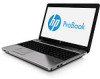
HP ProBook 4545s HP Notebook User Guide - Linux
HP ProBook 4545s Manual
 |
View all HP ProBook 4545s manuals
Add to My Manuals
Save this manual to your list of manuals |
HP ProBook 4545s manual content summary:
- HP ProBook 4545s | HP Notebook User Guide - Linux - Page 1
HP Notebook User Guide - HP ProBook 4545s | HP Notebook User Guide - Linux - Page 2
. Some features may not be available on your computer. To obtain the latest information in this guide, go to the HP Web site at http://www.hp.com/support. Software terms By installing, copying, downloading, or otherwise using any software product preinstalled on this computer, you agree to be bound - HP ProBook 4545s | HP Notebook User Guide - Linux - Page 3
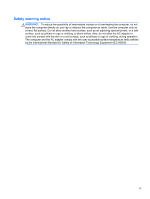
the computer air vents. Use the computer only on a hard, flat surface. Do not allow another hard surface, such as an adjoining optional printer, or a soft surface, such as pillows or rugs or clothing, to block airflow. Also, do not allow the AC adapter to come into contact with the skin or a soft - HP ProBook 4545s | HP Notebook User Guide - Linux - Page 4
iv Safety warning notice - HP ProBook 4545s | HP Notebook User Guide - Linux - Page 5
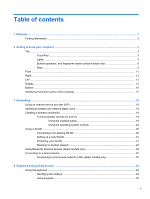
...19 Using an Internet service provider (ISP 19 Identifying wireless and network status icons 19 Creating a wireless connection ...19 Turning wireless devices on and off 19 Using the wireless button 19 Using the operating system controls 20 Using a WLAN ...20 Connecting to an existing - HP ProBook 4545s | HP Notebook User Guide - Linux - Page 6
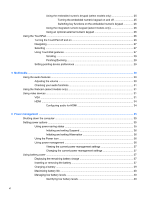
keypad 26 Using the TouchPad ...26 Turning the TouchPad off and on 26 Navigating battery power ...37 Displaying the remaining battery charge 37 Inserting or removing the battery 37 Charging a battery ...39 Maximizing battery life ...40 Managing low battery levels 40 Identifying low battery - HP ProBook 4545s | HP Notebook User Guide - Linux - Page 7
the battery ...42 Using external AC power ...42 Testing an AC adapter ...42 7 Drives ...44 Handling drives ...44 Using the optional security screw ...44 Removing or replacing the service door 45 Removing the service door 45 Replacing the service door 46 Replacing or upgrading the hard drive 47 - HP ProBook 4545s | HP Notebook User Guide - Linux - Page 8
in Computer Setup 70 Updating the BIOS ...70 Determining the BIOS version 70 Downloading a BIOS update 71 Using Advanced System Diagnostics 72 13 MultiBoot ...73 About the boot device order ...73 Enabling boot devices in Computer Setup 74 Considering boot order changes ...74 Choosing MultiBoot - HP ProBook 4545s | HP Notebook User Guide - Linux - Page 9
Dynamically choosing a boot device using the f9 prompt 76 Setting a MultiBoot Express prompt 76 Entering MultiBoot Express preferences 76 Appendix A Troubleshooting and support ...77 Troubleshooting ...77 The computer is unable to start up 77 The computer screen is blank 77 Software is - HP ProBook 4545s | HP Notebook User Guide - Linux - Page 10
x - HP ProBook 4545s | HP Notebook User Guide - Linux - Page 11
it will automatically be updated with the latest versions. When you register, you can choose to receive automatic notifications when updates become available. The automatic notifications for operating system updates are available for 90 days. You can also go to http://www.hp.com/support to download - HP ProBook 4545s | HP Notebook User Guide - Linux - Page 12
various tasks. Resources For information about Setup Instructions poster ● Setting up the computer ● HP Web site To access this Web site, go to http://www.hp.com/ support. ● Support information ● Ordering parts and finding additional help ● Software, driver, and BIOS updates ● Accessories - HP ProBook 4545s | HP Notebook User Guide - Linux - Page 13
(1) (2) TouchPad on/off button TouchPad zone (3) Left TouchPad button (4) Right TouchPad button Description Turns the TouchPad on and off. Moves the pointer and selects or activates items on the screen. Functions like the left button on an external mouse. Functions like the right button on an - HP ProBook 4545s | HP Notebook User Guide - Linux - Page 14
Off: The computer is off, in the Suspend state, or in Hibernation. ● White: An integrated wireless device, such as a wireless local area network (WLAN) device and/or a Bluetooth® device, is on. ● Amber: All wireless devices are off. ● Amber: The TouchPad is off. ● Off: The TouchPad is on. 4 Chapter - HP ProBook 4545s | HP Notebook User Guide - Linux - Page 15
. ● Off: The computer is off, in the Suspend state, or in Hibernation. ● White: An integrated wireless device, such as a wireless local area network (WLAN) device and/or a Bluetooth® device, is on. ● Amber: All wireless devices are off. ● Amber: The TouchPad is off. ● Off: The TouchPad is on. Top 5 - HP ProBook 4545s | HP Notebook User Guide - Linux - Page 16
fingerprint reader (select models only) NOTE: Refer to the illustration that most closely matches your computer. Component (1) (2) (3) Power button Speakers (2) Web browser button (select models only) Description ● When the computer is off, press the button to turn Computer > Control Center. 2. - HP ProBook 4545s | HP Notebook User Guide - Linux - Page 17
(5) Fingerprint reader (select models only) Description Turns the wireless feature on or off but does not establish a wireless connection. NOTE: A wireless connection may be established if one has been previously configured. Allows a fingerprint logon to the operating system, instead of a password - HP ProBook 4545s | HP Notebook User Guide - Linux - Page 18
your power settings: 1. Select Computer > Control Center. 2. In the left pane, click Opens the default Web browser. (4) Wireless button Turns the wireless feature on or off but does Fingerprint reader (select models only) Allows a fingerprint logon to the operating system, instead of a password - HP ProBook 4545s | HP Notebook User Guide - Linux - Page 19
when pressed in combination with the fn key. For more information, see Keyboard and pointing devices on page 24 Can be used like the keys on corner of the key. Displays a shortcut menu for items beneath the cursor. Turns the embedded numeric keypad on and off when pressed in combination with the fn - HP ProBook 4545s | HP Notebook User Guide - Linux - Page 20
pressed in combination with the fn key. For more information, see Keyboard and pointing devices on page 24 Displays a shortcut menu for The keypad function that is active when the computer is turned off is reinstated when the computer is turned back on. Can be used like an external numeric keypad - HP ProBook 4545s | HP Notebook User Guide - Linux - Page 21
Description ● Blinking white: The hard drive or optical drive is being accessed. ● Amber: HP 3D DriveGuard has temporarily parked the hard drive. Supports the following digital card formats: ● Memory Stick PRO ● Memory Stick PRO Duo (needs an adapter) ● MultiMediaCard (MMC) ● MultiMediaCardPlus (MMC - HP ProBook 4545s | HP Notebook User Guide - Linux - Page 22
Description Connect an optional USB device. Optical drive (select models only) Reads an optical disc. NOTE: On select models, the optical drive also writes to an optical disc. Optical drive light (select models only) Lights when the optical drive is active. Optical drive eject button (select - HP ProBook 4545s | HP Notebook User Guide - Linux - Page 23
(3) AC adapter/battery light (4) Vent (5) External monitor port (6) RJ-45 (network) jack (7) HDMI port (8) USB 3.0 from being mishandled or stolen. Connects an AC adapter. ● Amber: The computer is connected to external power and the battery is charged from 0 to 90 percent. ● White - HP ProBook 4545s | HP Notebook User Guide - Linux - Page 24
and receive wireless signals to communicate with wireless local area networks (WLAN). (2) Internal microphone(s} (1 or 2 depending models only) Records video and captures still photographs. (5) Internal display switch Turns off the display or initiates Suspend if the display is closed while the - HP ProBook 4545s | HP Notebook User Guide - Linux - Page 25
and receive wireless signals to communicate with wireless local area networks (WLAN). (2) Internal microphone(s) (1 or 2 depending on only) Records video and captures still photographs. (5) Internal display switch Turns off the display or initiates Suspend if the display is closed while 15 - HP ProBook 4545s | HP Notebook User Guide - Linux - Page 26
in this section. Component (1) (2) Battery and service door release latches Battery bay Description ● Releases the battery from the battery bay by sliding the release latches one time. ● When the battery has been removed from the battery bay, releases the service door from the computer by sliding - HP ProBook 4545s | HP Notebook User Guide - Linux - Page 27
Component (3) Service door (4) Vents (2) Description Protects the hard drive bay, the wireless LAN (WLAN) module slot, and the memory module slots. CAUTION: To prevent an unresponsive system, replace the wireless module only with a wireless module authorized for use in the computer by the - HP ProBook 4545s | HP Notebook User Guide - Linux - Page 28
Component (2) (3) Description Hard drive WLAN module slot (select models only) 18 Chapter 2 Getting to know your computer - HP ProBook 4545s | HP Notebook User Guide - Linux - Page 29
wireless devices on and off Using the wireless button Use the wireless button to turn both the wireless network controller and the Bluetooth controller off or on simultaneously. They can be controlled individually through Control Center or Computer Setup. Using an Internet service provider (ISP) 19 - HP ProBook 4545s | HP Notebook User Guide - Linux - Page 30
controls To enable or disable a wireless or wired network device: 1. Right-click the Network accessories that are linked by a wireless router or a wireless access point. NOTE: When creating a wireless connection or allowing access to users in a network, you are prompted for the root password - HP ProBook 4545s | HP Notebook User Guide - Linux - Page 31
and wireless router are synchronized. To synchronize your computer and wireless router, turn your computer and wireless router off and then back on. As your network grows, additional wireless and wired computers can be connected to the network to access the Internet. For help in setting up your WLAN - HP ProBook 4545s | HP Notebook User Guide - Linux - Page 32
HP key, others will not be able to use the WLAN. Roaming to another network When you move network, follow the same procedure you used initially to connect to your WLAN. Using Bluetooth wireless devices (select models only) A Bluetooth device provides short-range wireless communications that replace - HP ProBook 4545s | HP Notebook User Guide - Linux - Page 33
To connect the network cable: 1. Plug the network cable into the network jack (1) on the computer. 2. Plug the other end of the cable into a network wall jack (2) or a router (not illustrated). WARNING! To reduce the risk of electric shock, fire, or damage to the equipment, do not plug a modem or - HP ProBook 4545s | HP Notebook User Guide - Linux - Page 34
initiating Suspend. NOTE: If a critical battery level occurs while the computer is in Suspend, the computer initiates Hibernation and the information stored in memory is saved to the hard drive. fn+f2 Decreases the screen brightness level. fn+f3 Increases the screen brightness level. fn+f4 fn - HP ProBook 4545s | HP Notebook User Guide - Linux - Page 35
keypad. The computer also supports an optional external numeric keypad or an optional external keyboard that includes a numeric keypad : The embedded numeric keypad will not function while an external keyboard or numeric keypad is connected to the computer. When the keypad is turned on, it can be - HP ProBook 4545s | HP Notebook User Guide - Linux - Page 36
mouse (purchased separately) by connecting it to one of the USB ports on the computer. Turning the TouchPad off and on To turn the TouchPad off and on, quickly double-tap the TouchPad on/off button. NOTE: The TouchPad light is off when the TouchPad is on. 26 Chapter 4 Keyboard and pointing devices - HP ProBook 4545s | HP Notebook User Guide - Linux - Page 37
pointer to go. Selecting Use the left and right TouchPad buttons like the corresponding buttons on an external mouse. Using TouchPad gestures The TouchPad supports a variety of gestures. To use TouchPad gestures, place two fingers on the TouchPad at the same time. NOTE: TouchPad gestures are not - HP ProBook 4545s | HP Notebook User Guide - Linux - Page 38
device, and then click Settings. 4. Select the gesture to view information about its features. To turn the gestures on and off: 1. Select Computer > More Applications. 2. In the left pane, box next to the gesture that you want to turn on or off. 5. Click Apply, and then click OK. 28 Chapter - HP ProBook 4545s | HP Notebook User Guide - Linux - Page 39
in an up, down, left, or right motion. NOTE: Scrolling speed is controlled by finger speed. NOTE: Two-finger scrolling is enabled at the factory. Pinching/Zooming , click speed, pointer options, and so on: 1. Select Computer > Control Center. 2. In the left pane, click Hardware, and then click Mouse - HP ProBook 4545s | HP Notebook User Guide - Linux - Page 40
: ● Play music. ● Record sound. ● Download music from the Internet. ● Create multimedia presentations. the installed optical drive (select models only) or on an external optical drive (purchased separately Notices. NOTE: Volume can also be controlled through the operating system and some programs. - HP ProBook 4545s | HP Notebook User Guide - Linux - Page 41
sound options under Choose an alert sound to test each sound. To check the recording functions of the computer, follow these steps: 1. Select Computer > Control Center. 2. In the left pane, click Hardware, and then click Sound in the right pane. 3. Click the Input tab, and then select Microphone or - HP ProBook 4545s | HP Notebook User Guide - Linux - Page 42
laptop panel, an external display in combination with the laptop NOTE: If you have an AMD card, follow the instructions in the next section. AMD graphics card, follow these steps: 1. Select Computer >More Applications > System > ATI Catalyst Control Center (as Superuser). 2. Enter your root password - HP ProBook 4545s | HP Notebook User Guide - Linux - Page 43
5. Your display settings can be modified by clicking your monitor in the dialog box, and then selecting the Display properties tab or Multi-Display tab. 6. After the settings are configured, click Apply, and then click OK. Your computer may require rebooting. Using video devices 33 - HP ProBook 4545s | HP Notebook User Guide - Linux - Page 44
HDMI port on the computer. The information displayed on the computer screen can be simultaneously displayed on the HDMI device. To connect a the cable to the device, and then see the device manufacturer's instructions for additional information. Configuring audio for HDMI To configure HDMI audio, - HP ProBook 4545s | HP Notebook User Guide - Linux - Page 45
then turns off the display and computer. Shut down the computer under any of the following conditions: ● When you need to replace the battery or access components inside the computer ● When you are connecting an external hardware device that does not connect to a USB port ● When the computer will be - HP ProBook 4545s | HP Notebook User Guide - Linux - Page 46
, the power lights turn on and your work returns to the screen where you stopped working. Using the Power icon The Power icon is located in the notification area, at the far right of the taskbar. The Power icon allows you to quickly access power settings, view remaining battery charge, and select - HP ProBook 4545s | HP Notebook User Guide - Linux - Page 47
and the computer is plugged into external AC power, the computer runs on AC power. If the computer contains a charged battery and is running on external AC power supplied through the AC adapter, the computer switches to battery power if the AC adapter is disconnected from the computer. NOTE: When - HP ProBook 4545s | HP Notebook User Guide - Linux - Page 48
loss of information, save your work and initiate Hibernation or shut down the computer before removing the battery. 1. Slide the battery release latches (1) to release the battery. NOTE: You can slide the battery release latches simultaneously or you can slide them one at a time. 38 Chapter 6 Power - HP ProBook 4545s | HP Notebook User Guide - Linux - Page 49
upward (2), and remove it (3) from the computer. Charging a battery WARNING! Do not charge the computer battery while you are onboard aircraft. The battery charges whenever the computer is plugged into external power through an AC adapter or an optional power adapter. The battery charges whether the - HP ProBook 4545s | HP Notebook User Guide - Linux - Page 50
slider to the right of Put display to sleep when inactive for to 15 minutes, and select the check box next to Reduce backlight brightness. 5. Select the check box next to Dim display when idle. 6. Click Close. CAUTION: Removing a battery that is the sole power source for the computer can cause loss - HP ProBook 4545s | HP Notebook User Guide - Linux - Page 51
: ● AC adapter ● Optional docking or expansion device ● Optional power adapter purchased as an accessory from HP Resolving a low battery level when a charged battery is available 1. Turn off the computer or initiate Hibernation. 2. Replace the discharged battery with a charged battery. 3. Turn on - HP ProBook 4545s | HP Notebook User Guide - Linux - Page 52
Setup Instructions poster provided in the computer box. External AC power is supplied through an approved AC adapter or an optional docking or expansion device. WARNING! To reduce potential safety issues, use only the AC adapter provided with the computer, a replacement AC adapter provided by HP, or - HP ProBook 4545s | HP Notebook User Guide - Linux - Page 53
To test the AC adapter: 1. Shut down the computer. 2. Remove the battery from the computer. 3. Connect the AC adapter to the computer, and then plug it into an AC outlet. 4. Turn on the computer. ● If the power lights turn on, the AC adapter is functioning properly. ● If the power lights remain off, - HP ProBook 4545s | HP Notebook User Guide - Linux - Page 54
to an external hard drive, initiate Suspend and allow the screen to clear, or properly disconnect the external hard drive. ● Before handling a drive, discharge static electricity by touching the unpainted metal surface of the drive. ● Do not touch the connector pins on a removable drive or on the - HP ProBook 4545s | HP Notebook User Guide - Linux - Page 55
service door in place. Removing or replacing the service door CAUTION: To prevent information loss or an unresponsive system: Save your work and shut down the computer before adding or replacing a memory module or hard drive. If you are not sure whether the computer is off or in Hibernation, turn - HP ProBook 4545s | HP Notebook User Guide - Linux - Page 56
the front of the computer (3) and lift (4) to remove the service door. Replacing the service door Replace the service door after accessing the memory module slot, hard drive, regulatory label, and other components. To replace the service door: 1. Tilt the service door down to align the tabs on the - HP ProBook 4545s | HP Notebook User Guide - Linux - Page 57
screw on page 44). 3. Replace the battery (see Inserting or removing the battery on page 37). 4. Turn the computer right-side up, and then reconnect AC power and external devices to the computer. 5. Turn on the computer. Replacing or upgrading the hard drive CAUTION: To prevent information loss - HP ProBook 4545s | HP Notebook User Guide - Linux - Page 58
8. Remove the service door (see Removing or replacing the service door on page 45). NOTE: Instructions for removing the hard drive are imprinted on the service door. 9. Remove the four hard drive screws (1) from the hard drive. 10. Pull the plastic tab on the hard drive (2) towards the side of the - HP ProBook 4545s | HP Notebook User Guide - Linux - Page 59
(see Using the optional security screw on page 44. 6. Replace the battery (see Inserting or removing the battery on page 37). 7. Turn the computer right-side up, and then reconnect AC power and external devices to the computer. 8. Turn on the computer. Replacing or upgrading the hard drive 49 - HP ProBook 4545s | HP Notebook User Guide - Linux - Page 60
including your optical drive, is displayed. Inserting an optical disc Tray-load 1. Turn on the computer. 2. Press the eject button (1) on the drive bezel to release you want to use the media content. Removing an optical disc Tray-load There are 2 ways to remove a disc, depending on whether the disc - HP ProBook 4545s | HP Notebook User Guide - Linux - Page 61
NOTE: If the tray is not fully accessible, tilt the disc carefully as you remove it. 3. Close the disc tray and place the disc in a protective case. a paper clip (1) into the release access in the front bezel of the drive. 2. Press in gently on the paper clip until the tray is released, and - HP ProBook 4545s | HP Notebook User Guide - Linux - Page 62
the disc by the edges and avoid touching the flat surfaces. NOTE: If the tray is not fully accessible, tilt the disc carefully as you remove it. 4. Close the disc tray and place the disc in a protective case. 52 Chapter - HP ProBook 4545s | HP Notebook User Guide - Linux - Page 63
of loss of data or an unresponsive system, use the following procedure to safely remove the digital card. Save your information and close all programs associated with the digital card. To remove a digital card: 1. Open File Browser by selecting Computer > Nautilus. 2. In the Places list in the left - HP ProBook 4545s | HP Notebook User Guide - Linux - Page 64
, refer to the manufacturer's instructions. The computer has at least 1 USB port that supports USB 1.0, 1.1, 2.0, or 3.0 devices. Your computer may also have a USB charging port that provides power to an external device. An optional docking device or USB hub provides additional USB ports that can be - HP ProBook 4545s | HP Notebook User Guide - Linux - Page 65
the Eject icon next to the name of the device. 3. Remove the device. Using optional external devices NOTE: For more information about required software and drivers, or to learn which computer port to use, refer to the manufacturer's instructions. To connect an external device to the computer: Using - HP ProBook 4545s | HP Notebook User Guide - Linux - Page 66
A USB drive can be added by connecting the drive to a USB port on the computer. USB drives include the following types: ● 1.44-megabyte diskette drive ● External hard drive (a hard drive with an adapter attached) ● External optical drive (CD and DVD) ● MultiBay device 56 Chapter 8 External cards and - HP ProBook 4545s | HP Notebook User Guide - Linux - Page 67
a dual-channel configuration when adding a second memory module, be sure that both memory modules are identical. To replace a memory module: CAUTION: To prevent information loss or an unresponsive system: Shut down the computer before adding or replacing memory modules. Do not remove a memory module - HP ProBook 4545s | HP Notebook User Guide - Linux - Page 68
edges only. Do not touch the components on the memory module. To protect a memory module after removal, place it in an electrostatic-safe container. 8. Insert a new memory module: CAUTION: To prevent damage to the memory module, hold the memory module by the edges only. Do not touch the components - HP ProBook 4545s | HP Notebook User Guide - Linux - Page 69
service door (see Removing or replacing the service door on page 45). 10. Replace the security screw, if desired (see Using the optional security screw on page 44. 11. Replace the battery (see Inserting or removing the battery on page 37). 12. Turn the computer right-side up, and then reconnect AC - HP ProBook 4545s | HP Notebook User Guide - Linux - Page 70
Setup (f10) BIOS Administrator password in Computer Setup* Unauthorized access to the contents of a hard drive DriveLock password in Computer Setup* Unauthorized startup from an optical drive, diskette drive, or internal network adapter Unauthorized access to data Boot options feature in - HP ProBook 4545s | HP Notebook User Guide - Linux - Page 71
Setup passwords Function BIOS administrator password* Protects access to Computer Setup. DriveLock master password* Protects access to the internal hard drive that is protected by DriveLock. It is also used to remove DriveLock protection. This password is set under DriveLock Passwords during - HP ProBook 4545s | HP Notebook User Guide - Linux - Page 72
day-to-day user of the protected hard drive. The owner of the master password may be either a system administrator or the day-to-day user. ● The user password and the master password can be identical. ● You can delete a user password or master password only by removing DriveLock protection from the - HP ProBook 4545s | HP Notebook User Guide - Linux - Page 73
master password will be used to unlock the drive. NOTE: You must have a BIOS administrator password before you can access the Automatic DriveLock features. Managing an Automatic DriveLock password To enable or disable an Automatic DriveLock password in Computer Setup, follow these steps: 1. Turn on - HP ProBook 4545s | HP Notebook User Guide - Linux - Page 74
or file sharing on a network, or block authorized e-mail attachments. To temporarily resolve the problem, disable the firewall, perform . NOTE: When modifying firewall settings, you are prompted for the root password. Installing an optional security cable NOTE: A security cable is designed to - HP ProBook 4545s | HP Notebook User Guide - Linux - Page 75
lock with the key. 4. Remove the key and keep it in a safe place. Using the fingerprint reader (select models only) An integrated fingerprint reader is available on select computer models. In order to use the fingerprint reader, you must set up a user account with a password on the computer. This - HP ProBook 4545s | HP Notebook User Guide - Linux - Page 76
Follow the on-screen instructions to enroll your fingerprint. NOTE: After your fingerprint is enrolled, you can swipe your finger on the fingerprint reader when you turn on the computer, unlock the computer, or resume from the Suspend or Hibernation state, instead of typing a password. 66 Chapter 10 - HP ProBook 4545s | HP Notebook User Guide - Linux - Page 77
optical drive and restart the computer. 3. As the computer is restarting, press f9 to open the Computer Setup boot option menu. 4. Select the Notebook Upgrade Bay option. 5. Using the arrow keys, select Yes when prompted: Do you want to start the System-Restore? 6. Follow the on-screen instructions - HP ProBook 4545s | HP Notebook User Guide - Linux - Page 78
to maintain a current backup. You can manually back up your information to an optional external drive, a network drive, or discs. Back up your system location to save the backup files. 4. Click the Save and Backup button to start the backup and to save the backup settings. To restore backup files: 1. - HP ProBook 4545s | HP Notebook User Guide - Linux - Page 79
can prevent the computer from operating properly. Starting Computer Setup NOTE: An external keyboard or mouse connected to a USB port can be used with Computer Setup only if USB legacy support is enabled. To start Computer Setup, follow these steps: 1. Turn on or restart the computer, and then - HP ProBook 4545s | HP Notebook User Guide - Linux - Page 80
the on-screen instructions. - or - Use the tab key and the arrow keys to select File > Save Changes and Exit, and then press enter. Your changes go into effect when the computer restarts. Restoring factory settings in Computer Setup NOTE: Restoring defaults will not change the hard drive mode. To - HP ProBook 4545s | HP Notebook User Guide - Linux - Page 81
external power using the AC adapter. Do not download or install a BIOS update while the computer is running on battery power, docked in an optional docking device, or connected to an optional power source. During the download and installation, follow these instructions: Do not disconnect power - HP ProBook 4545s | HP Notebook User Guide - Linux - Page 82
tests on memory modules, hard drive SMART attributes, the hard drive surface, the battery (and battery calibration), video memory, and the WLAN module status. You can view system information and error logs in the Advanced System Diagnostics window. To start Advanced System Diagnostics: 1. Turn on or - HP ProBook 4545s | HP Notebook User Guide - Linux - Page 83
locations listed may not be supported on your computer. ● Notebook upgrade bay ● Optical drive ● Notebook hard drive ● USB diskette drive ● USB CD-ROM ● USB hard drive ● Notebook Ethernet ● Secure Digital (SD) Memory Card ● Docking station upgrade bay ● External SATA drive You can change the order - HP ProBook 4545s | HP Notebook User Guide - Linux - Page 84
to an optional docking device that contains a hard drive, this hard drive will be shown in the boot order as a USB hard drive. If the system attempts to boot from this USB hard drive and fails, it will not attempt to boot to the hard drive in the hard drive bay. Instead, it will try to boot to the - HP ProBook 4545s | HP Notebook User Guide - Linux - Page 85
with the NIC. ● Drives in an optional docking device are treated like external USB devices in the boot order. Choosing MultiBoot preferences You can use MultiBoot in the following ways: ● To set a new boot order that the computer uses each time it is turned on, by changing the boot order in Computer - HP ProBook 4545s | HP Notebook User Guide - Linux - Page 86
Boot startup location menu is not displayed.) 5. To save your changes and exit Computer Setup, click the Save icon in the lower-left corner of the screen, and then follow the on-screen instructions will not start until you select a boot device and press enter. ● To allow the computer to start - HP ProBook 4545s | HP Notebook User Guide - Linux - Page 87
into an external power source other than an AC outlet, plug the computer into an AC outlet using the AC adapter. Be sure that the power cord and AC adapter connections are secure. The computer screen is blank If the screen is blank but you have not turned off the computer, one or more of these - HP ProBook 4545s | HP Notebook User Guide - Linux - Page 88
● Disconnect the computer from external power and remove the battery. The computer is unusually warm It is adapter and to the cable or DSL modem, and that the lights are on. ● Disconnect and then reconnect all cables, and turn the power off and then back on. 78 Appendix A Troubleshooting and support - HP ProBook 4545s | HP Notebook User Guide - Linux - Page 89
the front bezel of the drive. 2. Press in gently on the paper clip until the disc tray is released, and then pull out the tray (2) until it stops. 3. Remove the disc (3) from the the disc carefully as you remove it. 4. Close the disc tray and place the disc in a protective case. Troubleshooting 79 - HP ProBook 4545s | HP Notebook User Guide - Linux - Page 90
: a. Right-click on a blank area of the computer desktop, and select Screen resolution. b. Specify a primary display and a secondary display. NOTE: When using both displays, the DVD image will not appear on any display designated as the secondary display. 80 Appendix A Troubleshooting and support - HP ProBook 4545s | HP Notebook User Guide - Linux - Page 91
disc, and then burn from your hard drive. Contacting support If the information provided in this guide or in Linux Help does not address your questions, you can contact support. For U.S. support, go to http://www.hp.com/go/contactHP. For worldwide support, go to http://welcome.hp.com/country/us/en - HP ProBook 4545s | HP Notebook User Guide - Linux - Page 92
you may need when you troubleshoot system problems or travel internationally with the computer: ● Service label-Provides important information, information available when you contact technical support. The service label is affixed inside the battery bay. ● Regulatory label-Provides regulatory - HP ProBook 4545s | HP Notebook User Guide - Linux - Page 93
shock or damage to components, do not attempt to clean your computer while it is turned on: Turn off the computer. Disconnect external power. Disconnect all powered external devices. CAUTION: Do not cover of the computer, use a circular motion to aid in removing dirt and debris. Cleaning products 83 - HP ProBook 4545s | HP Notebook User Guide - Linux - Page 94
one of the cleaning solutions listed previously or use an acceptable germicidal disposable wipe. ● To prevent keys from sticking and to remove dust, lint, and particles from the keyboard, use a can of compressed air with a straw extension. WARNING! To reduce the risk of electric shock or damage to - HP ProBook 4545s | HP Notebook User Guide - Linux - Page 95
source, it should be powered only with an AC adapter or a DC power source supplied and approved by HP for use with this computer. The computer can Nonoperating Metric 5°C to 35°C -20°C to 60°C 10% to 90% 5% to 95% -15 m to 3,048 m -15 m to 12,192 m U.S. 41°F to 95°F -4°F to 140°F 10% to 90% - HP ProBook 4545s | HP Notebook User Guide - Linux - Page 96
drive, or loss of information, observe these precautions: ● If removal or installation instructions direct you to unplug the computer, unplug it after being properly grounded and before removing surface of the component. ● If you remove a component, place it in an - HP ProBook 4545s | HP Notebook User Guide - Linux - Page 97
41 battery and service door release latch 16 battery bay 82 battery cover 16 battery release latch 37 BIOS determining version 70 downloading an update 71 updating 70 BIOS administrator password creating 62 entering 62 managing 62 Bluetooth device 22 Bluetooth label 82 boot devices, enabling - HP ProBook 4545s | HP Notebook User Guide - Linux - Page 98
, 15 wireless 4, 5 local area network (LAN) cable required 22 connecting cable 22 logical drive designations 74 low battery level 40 M managing a BIOS administrator password 62 managing a DriveLock password 63 media card defined 53 inserting 53 removing 53 stopping 53 media controls, keys 25 memory - HP ProBook 4545s | HP Notebook User Guide - Linux - Page 99
optical drive 50 troubleshooting disc burning 81 disc play 80 external display 80 optical disc tray 79 optical drive detection 80 turning off the computer 35 U unresponsive system 35 USB cable, connecting 55 USB devices connecting 55 description 54 removing 55 USB hubs 54 USB legacy support 69 USB - HP ProBook 4545s | HP Notebook User Guide - Linux - Page 100
-
 1
1 -
 2
2 -
 3
3 -
 4
4 -
 5
5 -
 6
6 -
 7
7 -
8
-
9
-
10
-
11
-
12
-
13
-
14
-
15
-
16
-
17
-
18
-
19
-
20
-
21
-
22
-
23
-
24
-
25
-
26
-
27
-
28
-
29
-
30
-
31
-
32
-
33
-
34
-
35
-
36
-
37
-
38
-
39
-
40
-
41
-
42
-
43
-
44
-
45
-
46
-
47
-
48
-
49
-
50
-
51
-
52
-
53
-
54
-
55
-
56
-
57
-
58
-
59
-
60
-
61
-
62
-
63
-
64
-
65
-
66
-
67
-
68
-
69
-
70
-
71
-
72
-
73
-
74
-
75
-
76
-
77
-
78
-
79
-
80
-
81
-
82
-
83
-
84
-
85
-
86
-
87
-
88
-
89
-
90
-
91
-
92
-
93
-
94
-
95
-
96
-
97
-
98
-
99
-
100
 |
 |

HP Notebook
User Guide